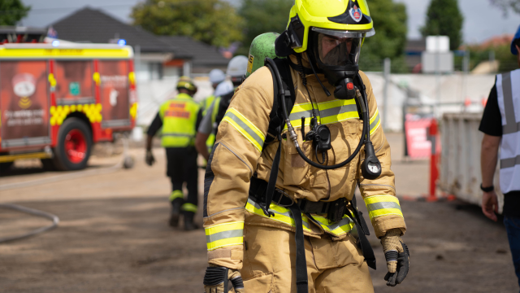
Fire Fit
Firefighting is a physically demanding occupation. We put life first and train to get it right.
Tasks include carrying heavy loads such as personal protective equipment, handling temperature extremes, variable terrains and confined spaces, all of which impose unique physical and physiological demands on firefighters.
The FireFit Training Guide is based on an 8-12 week program, depending on each individual's fitness level, and is available to help eligible candidates prepare for the Physical Aptitude Test (PAT) during the recruitment campaign.
The PAT is an assessment of the inherent requirements of firefighting and has been designed specifically to identify and recruit individuals who are physiologically capable of tolerating the work-related demands of firefighting.
We encourage you to start training as early as possible to reach and maintain the required level of fitness.
Train Like a Firefighter
We have created a series of exercise focused videos which show you how each exercise relates to the physical demands required of firefighters.
A high degree of strength and endurance is crucial for firefighters to enable the safe and effective execution of operational duties. This includes more than fire, with HAZMAT, Rescue and natural disaster relief jobs contributing to the overall workload. To best prepare for these tasks, both maximal strength and muscular endurance should be targeted and depending on your focus, this will influence the weights and repetitions used in the gym.
Happy training!
Importance of training both strength and endurance
A high degree of strength and endurance is crucial for firefighters to enable the safe and effective execution of operational duties. This includes more than fire, with HAZMAT, Rescue and natural disaster relief jobs contributing to the overall workload.
Cardiovascular endurance
Firefighters need cardio endurance to perform prolonged jobs. These are often made even harder by hot environments, wearing heavy protective clothing and using heavy equipment. The heart is another muscle in the body that needs to be trained, just like your legs. High intensity interval training is one of the best ways to do this and will improve your cardiovascular endurance.
Vertical push progressions
Many firefighting tasks need real upper body strength. Like carrying and raising ladders, that are heavy and awkward to handle. To train for this, practice vertical push progressions with a focus on maximum strength.
Deadlift and squats
Some rescues require firefighters to lift over 100kg. To prepare for this, Firefighters practice deadlifts and squats with a focus on maximum strength. The stronger your squat and deadlift are, the more capacity you will have to lift someone or something off the ground.
Split squat and step ups
Many operational tasks require heavy objects to be carried or dragged through varying terrains. This includes up and down stairs, through the bush or in confined spaces. To prepare for this, firefighters train by doing split squats and step ups with a focus on muscular endurance.
Prepare for the PAT
Interested in learning more about what the Physical Aptitude Test (PAT) involves? Have a look through our PAT videos to learn more about what to expect:
- The videos show each of the tasks that make up the PAT
- The PAT is performed as a circuit
- Candidates should note the criteria and requirements for each task
- Candidates must not run at any point during the PAT
- Rest can be taken between tasks but this will increase the overall time of the PAT completion
Stage 1
This stage is not timed.
- Reduced visibility search
- Ladder simulation
Stage 2
- Single-sided jerry can carry
- Stair climb with single-sided jerry can carry
- Rescue tool static holds
- Repeated hose drag
Firefighters generally complete this stage in under 15 minutes.
Candidates will not progress to stage 3 before 15 minutes so they are encouraged to pace themselves throughout this part.
If you complete this stage before the 15 minutes is up, you may use this time for recovery before stage 3
Stage 3
- Fire attack simulation
- Firefighter rescue
Firefighters generally complete this stage in under 2 minutes.
Physical Aptitude Test FAQs
Candidates are required to be successful completed the Physical Aptitude Test (PAT) on their first attempt.
Preparation is strongly recommended and should focus on:
- Cardiovascular fitness
- Strength and endurance
- Functional movements similar to firefighting tasks
Candidates are encouraged to begin preparation several months in advance. See Careers Page for all information in relation to the PAT.
Yes. You must obtain a Medical Clearance Form from your doctor and submit it to recruitment in the specified time before your scheduled PAT. Candidates who do not submit medical clearance will not be permitted to undertake the PAT.
The PAT is completed in two mandatory stages on the same day:
- PAT Safety Briefing – equipment familiarisation and safety instructions
- PAT Assessment – completion of the physical test course
You must complete the safety briefing before undertaking the PAT.
The Physical Aptitude Test (PAT) is an assessment of the inherent physical requirements of firefighting. It has been designed specifically to identify candidates who are physiologically capable of tolerating the work‑related demands of firefighting.
Firefighting is physically and psychologically demanding, particularly during major emergencies, and the PAT forms part of FRNSW’s duty of care to firefighters, their colleagues and the community.
FRNSW uses the PAT to ensure candidates can:
- Safely perform essential firefighting tasks
- Tolerate sustained physical work while wearing firefighter personal protective equipment
- Perform duties without significantly increasing the risk of injury to themselves or others.
No. The PAT is not a gym‑based fitness test. It is a task‑based assessment that reflects work undertaken by firefighters at emergency incidents and assesses functional capability rather than general fitness alone.
The PAT consists of three stages, with each stage assessing different physical tasks relevant to firefighting. Candidates must successfully complete each stage to progress to the next. The stages collectively assess strength, endurance, coordination and the ability to work safely managing heat stress and physical loads.
Stage 1 of the PAT is not timed. Stages 2 and 3 involve completing tasks under sustained physical load whilst wearing personal protective equipment. The structure reflects real operational conditions rather than speed alone.
Candidates complete the PAT wearing firefighter personal protective equipment (PPE) supplied by FRNSW with normal exercise/gym gear underneath. Jogger/gym shoes must also be worn and candidates will have ankle weights added to simulate the weight of structural firefighting boots.
Yes. The PAT is a standardised assessment, and all candidates are required to meet the same minimum standard regardless of age, gender or background.
The PAT tasks are outlined in official FRNSW material. Candidates are encouraged to focus on gradual and consistent progression of all required physical attributes rather than just focusing on replicating individual tasks exactly. The Fire Fit Training Guide outlines the best approach, which includes regular (monthly) ‘check in’ workouts that are similar to the PAT task course.
Candidates who do not meet the required standard at any stage of the PAT will not progress further in the recruitment process for that campaign.
Yes. Candidates must be medically fit to safely complete the PAT. Medical clearance requirements are communicated prior to the PAT stage as part of the recruitment process.
No. Successfully completing the PAT allows candidates to progress to the next stage of the recruitment process. Candidates must also successfully complete subsequent assessment stages before being considered for employment.
The PAT is one step in a multi‑stage recruitment process, which also includes assessment centre activities, medical assessment and employment checks.
